






 Spell
 Field
Witch of the White Forest
Archetype:
White Forest
View:
1763
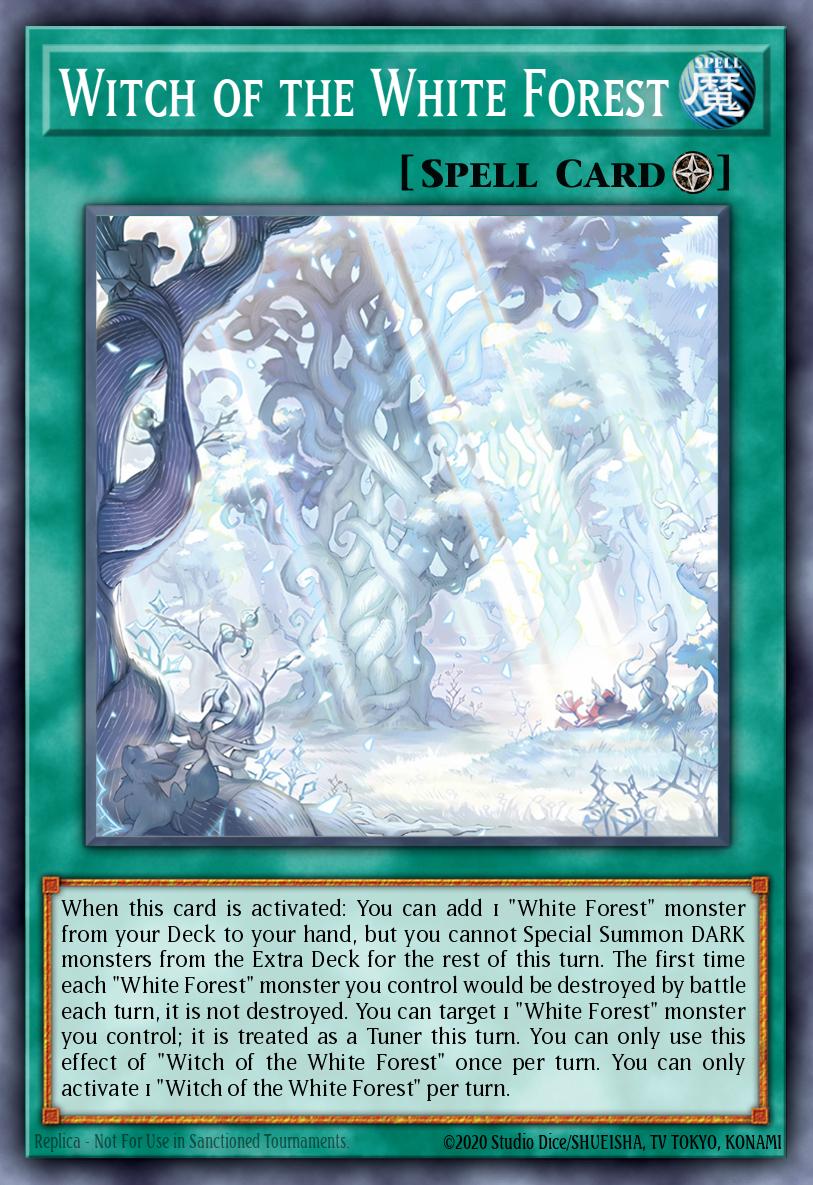
When this card is activated: You can add 1 "White Forest" monster from your Deck to your hand, but you cannot Special Summon DARK monsters from the Extra Deck for the rest of this turn. The first time each "White Forest" monster you control would be destroyed by battle each turn, it is not destroyed. You can target 1 "White Forest" monster you control; it is treated as a Tuner this turn. You can only use this effect of "Witch of the White Forest" once per turn. You can only activate 1 "Witch of the White Forest" per turn.
Witch of the White Forest — Power Evaluation
Final Score: 55 ± 6 · Confidence: Medium
- Intrinsic: 52 · Deck: 57 · Meta: provisional
- Primary role: Searcher/Tutor · Secondary: Starter, Extender
Why it scores here
The card's main value is a one-card Deck-to-hand search for a White Forest monster on activation, which is why it is a near-universal 3-copy staple in the archetype's decks (400 of 400 sampled decks, 2.54 average copies). The rest of its text is a once-per-turn-per-monster battle-destruction protection and a Tuner grant, both of which are supporting value rather than board-making. The combo sample (3 boards, average power index 22.3, zero boss or end monsters in every example) shows that the card converts into resources and a starter, not into a disruptive board, so its score is held down by a low combo_conversion and a low effect_interaction. High deck inclusion and the 100% usage-statistics inclusion confirm consistent play in the archetype and did not raise the score on their own; the self-restriction on DARK Extra Deck Special Summons earns a small deduction.
Axis scores
| Axis | Score | Evidence |
|---|---|---|
| Accessibility | 78 | Searches a White Forest monster from Deck on activation and is run at 3 copies in 279 of 400 decks; the opening-hand rate is inferred, not measured (observed, inferred). |
| Combo & Conversion | 35 | Average power index 22.3 across 3 boards, with board and disruption scores of 0 in every example; the card's searched body is the only conversion step shown (observed). |
| Resource Economy | 55 | Its search is a +1 card-advantage effect, but the recorded netCardAdvantage is 0 in all three boards, so the refuel value is mostly inferred from text (verified, observed). |
| Effect & Interaction | 25 | The battle-destruction protection only shields White Forest monsters and does not affect the opponent's cards or board (verified). |
| Material Utility | 20 | The card is a Spell and never a material; its Tuner grant applies to a White Forest monster for one turn, which is an enabler rather than a body (verified, inferred). |
| Resilience & Flexibility | 40 | A Spell that is easy to negate, with protection that is limited to once per monster per turn and a single activation per turn (verified, inferred). |
| Deck-Building Efficiency | 65 | Run at 3 copies with no garnet or lock beyond a one-turn DARK Extra Deck Special Summon restriction; the average copy count shows the slot is cheap to run (observed, verified). |
Calculation
Weight profile: 0.7 Searcher/Tutor + 0.3 Starter (secondary Extender weights not blended: Extender weights are close to Starter and the role is a minor Tuner grant). Intrinsic ≈ 52, Deck ≈ 57, Meta = provisional. Modifiers: Self-locking restriction (-2). Final formula: 0.40*Intrinsic + 0.60*Deck
Strengths
- Deck-to-hand search for a White Forest monster on activation, which keeps the card's value live in most hands.
- Run at 3 copies in most decks, so the search is consistent and redundant.
- Battle-destruction protection per monster per turn, which helps the archetype's board survive combat.
- Gives a White Forest monster Tuner status for a turn, which enables Synchro lines.
Weaknesses
- Spell card with no direct board or disruption, so combos built around it still need a separate payoff.
- Once-per-turn activation and a one-turn restriction on DARK Extra Deck summons limit how far it can be used in one turn.
- Its power depends on the White Forest archetype; it does not travel to other homes.
- Easy to negate, and the protection only matters in battle.
Counters / choke points
- Negating the Spell on activation stops the search and the restriction, though the card is not a hand trap.
- Opponent board wipes or battle-avoidance cards reduce the value of the protection clause.
Best use
Searcher for White Forest monsters, with Tuner and battle-protection support. Decks: White Forest, Azamina, Diabellestarr, Elfnote. Suggested copies: 3.
Evidence & gaps
- Verified: Spell Card with race Field, White Forest archetype, legal in TCG, OCG and MasterDuel (card text and formats).; Activation adds 1 White Forest monster from Deck to hand; prevents DARK Extra Deck Special Summons for the rest of the turn; battle-destruction protection once per monster per turn; Tuner grant on one White Forest monster for the turn; once-per-turn activation limit (card text).; Appears in 400 of 400 sampled decks, 3 copies in 279 decks, average 2.54 copies (deck statistic).; Usage statistics: 100% inclusion in the Diabellestarr and White Forest (gameplay 4 and 6) homes, 66.7% in Diabellstar (usage statistics).
- Observed: Appears in 3 of 3 recorded combos; starter in 1 combo; in end hand in 1 combo (combo statistic).; Average power index 22.3; board and disruption sub-scores are 0 in all three examples (combo statistic).; Top partners include Silvy, Tales and Diabell of the White Forest at 96-98% co-occurrence (deck statistic).
- Inferred: Primary role is Searcher/Tutor from the text; the combo sample shows it as a starter, not as a searched card, so Starter is a secondary role.; Opening-hand and draw rates are inferred from the 3-copy count and the search effect, not measured.; Battle-protection and Tuner clauses add value to the archetype's board but are not seen in the recorded combos.
- Data gaps: no guides supplied no banlist token; assumed 3 copies (unlimited) only 3 recorded combos; the combo sample is too small for a firm combo_conversion read no opening-hand or in-hand frequency for this card no direct measure of how often the Tuner or battle-protection clauses are used